← Back to the flight deck

Inside the simulation

How the
flight works.

Gravity, spacecraft engineering, and measured worlds.

A closer look at what the instruments tell you, from choosing an orbit to managing a loaded freighter.

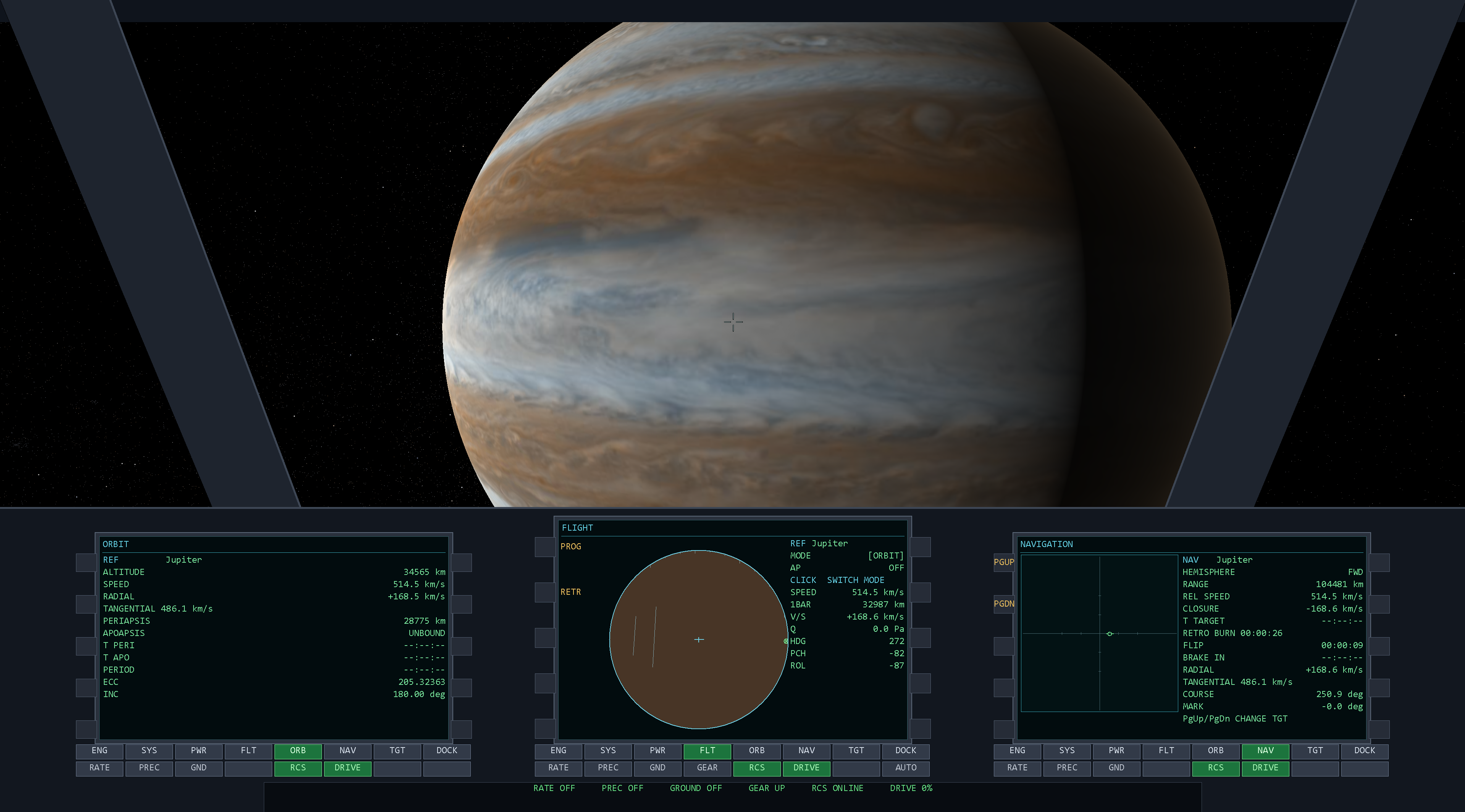
Jupiter seen through the cockpit, above orbital and navigation instruments
Jupiter / Orbital and navigation instruments

01 / Flight & motion

The rules of motion.

Celestial bodies move under gravity. Spacecraft motion accounts for relativistic momentum and energy. These three relations give a taste of the mathematics.

01 / Newton

Gravity bends the path.

F=GMmr2

Climb to orbital altitude without enough sideways speed, and you will fall back. Orbit depends on velocity as well as height.

Reading the equation

F is gravitational force; G is the gravitational constant; M and m are the masses; r is their separation. Doubling that separation reduces the force to one quarter. This relation describes point masses or non-overlapping spherical bodies.
02 / Kepler

Higher orbits take longer.

T2=4π2a3G(M+m)

Choose a larger orbit around the same body and each revolution takes longer. That timing matters when planning a rendezvous.

Period, size, and mass

T is orbital period; a is the semi-major axis of the relative orbit. This is Kepler's third law in its Newtonian form, for a bound two-body orbit. Other bodies perturb the path.

03 / Einstein

Speed changes the energy budget.

γ=11−v2c2

As velocity approaches light speed, each further increase requires more energy. The ship’s momentum and braking calculations account for that relationship.

What γ tells you

γ is the Lorentz factor; v is speed in the chosen inertial frame; c is the speed of light. At everyday speeds, this factor is very close to one.

The 2150 premise

Future propulsion.

The engines are speculative technology, built around the premise that humanity has made interplanetary travel practical. Further ahead, planned geodesic technology would open routes between star systems, carrying exploration beyond the familiar sky of Sol.

02 / Ship systems

The machinery matters.

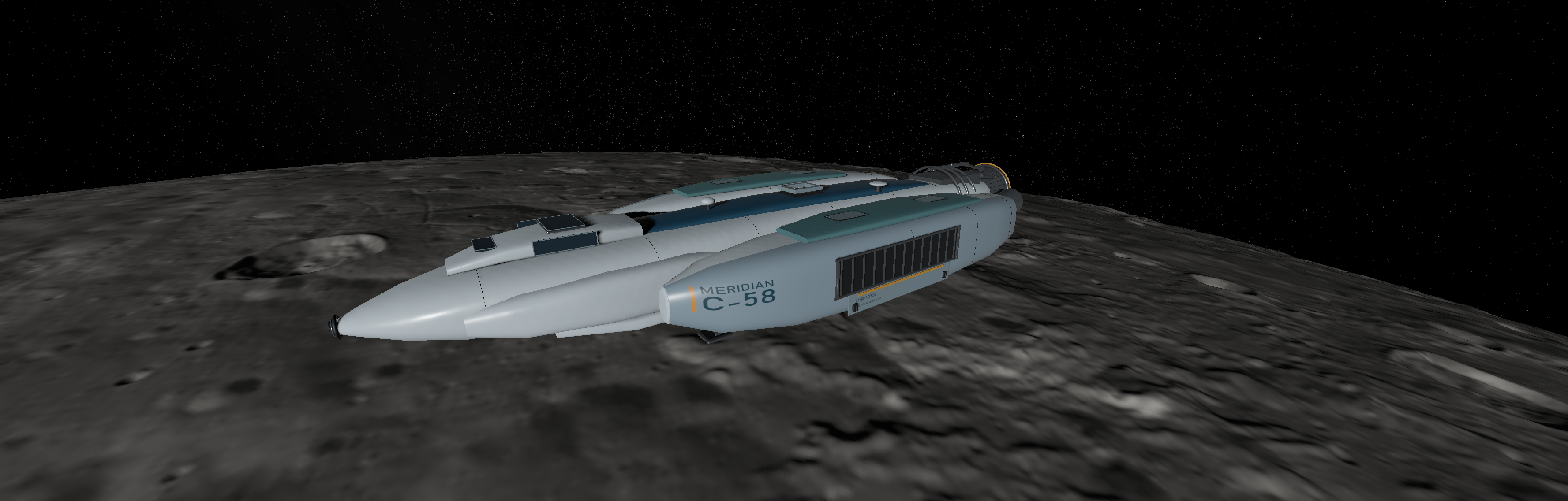
The Meridian C-58 above lunar terrain, with its cargo pods and engine visible
Meridian C-58 / Lunar flyover
01 Mass & payload
Cargo contributes to mass and inertia. A loaded freighter accelerates and rotates differently from an empty one.
02 Power & heat
High output draws on electrical capacity and builds heat. Thermal storage and heat rejection affect how long you can sustain a demanding burn.
03 Attitude & control
Pointing the nose does not redirect existing velocity. Rotational and translational thrusters let you line up with a port or correct a drifting approach.
04 Navigation & autonav
Automated transfers use the ship’s propulsion and control authority. Landing and docking remain pilot maneuvers.

Before you take off

How long is a journey to Jupiter?

Design targets range from roughly 4–10 hours in a starter ship to around an hour in an advanced vessel. Planetary positions, the load aboard, and final propulsion balancing affect those times.

Does flight run in real time?

Yes. There is no gameplay time acceleration. Autonav can handle the crossing, and you can save a flight to resume later.

Do I need to work out the mathematics?

The equations are optional reading. Flight assistance helps with control; the opening tutorial is still being designed.

03 / Measured worlds

From measurements
to terrain.

Elevation and imagery describe different things: the shape of the ground and its appearance.

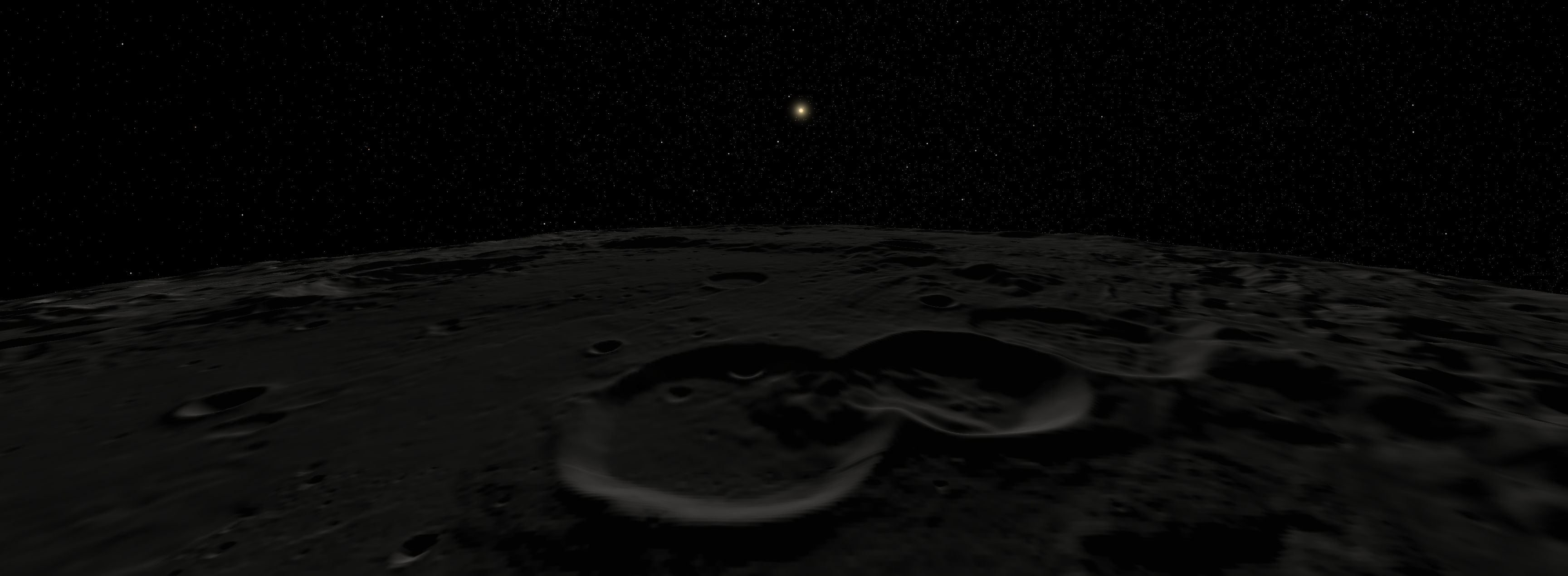
A wide view across the cratered lunar surface beneath a star-filled sky
Luna / In-simulator capture

Luna

Lunar topography.

NASA’s LOLA laser-altimeter data supplies elevations and crater profiles across the Moon.

Mars

Height and color.

MOLA supplies elevation; Viking imagery contributes surface color. Together they give the canyons their shape and appearance.

Surface detail

Reading the ground.

Broad landforms come from the datasets. Finer visual detail helps you judge motion and scale near the surface.

Back to the flight deck

See it in flight.

Watch the gameplay trailer